
VIBRATO NEWSROOM
US military to detonate toxic explosives in Iowa despite lead dust fears
The US Army will proceed with plans to detonate bomb-making chemicals in Iowa on Wednesday after a federal appeals court gave the controversial proposal the go-ahead.
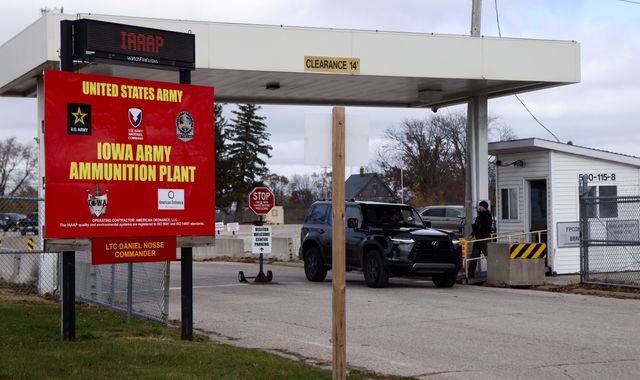
The planned explosion of lead azide at the Iowa Army Ammunition Plant in Middletown was due to go ahead last week, but the army rescheduled it three times amid fears the detonation could spread toxic lead dust across the area.
Environmental groups previously filed a lawsuit to halt the detonation, but the US Circuit Court of Appeals ruled on Monday that adequate safeguards have been put in place.
On Tuesday, officials told residents that barriers had been placed around the blast zone and they had made efforts to limit the plume from the detonation.
Major general Eric Shirley said: “Inaction is no longer an option.”
Officials argue the detonation is necessary because the chemicals have become increasingly unstable and dangerous with time.
In a legal filing seen by the Associated Press, the Justice Department said the wind on Wednesday is expected to be east to west or southwest, and away from high population areas and large bodies of water.
An emergency notification was sent to people’s phones in the area on Tuesday morning, warning some people within five miles (eight kilometres) southwest of the plant may be evacuated.
The “imminent threat alert” from the Federal Emergency Management Agency (FEMA) told those up to 20 miles (32 kilometres) away to remain indoors with windows closed “to avoid airborne lead dust, noise and vibration”.
On Monday, the army said it was proceeding with the controlled destruction of 68 barrels of lead azide in co-ordination with state, local and federal authorities.
“This is a consensus decision,” acting army secretary Adam Telle said on social media.
“Every expert agency agrees, and both Iowa‘s current and incoming governors say the call belongs to the experts.”
Donald Trump ordered the army to pause its plan until the court had cleared it. He added he also wanted incoming Democratic Governor Rob Sand to approve the detonation.
Mr Sand, who does not take office until January, said the decision falls on the Trump administration.
On Sunday, he said on social media “no good options exist and the situation is more dangerous and unpredictable than it ever should have been”.
Giving their decision, a three-judge panel of the 8th US Circuit Court of Appeals said the US Environmental Protection Agency had adequately incorporated safeguards in an emergency permit to minimise the dispersal of dust.
The panel pointed to barriers put up around the area where the barrels are stored, weather restrictions, air modelling, environmental monitoring and sampling, and requirements for advance public notice.
More on Sky News:
What we learned from Trump, Xi and Putin talks
Trump could erase his criminal record
Some residents near the detonation site in Middletown have already been sealing their windows and doors as a precaution.
Others who live further away expressed concerns on social media about the possible paths that the lead dust could take depending on the wind.
Officials acknowledge lead is toxic and have recommended people stay indoors when the detonation occurs.
They have also urged people to clean off outdoor surfaces with water afterwards to limit exposure to any lead particles.
A munitions emergency response specialist said in court documents filed over the weekend that the chemicals had become more sensitive as crystals formed inside the barrels.
“Even a small amount of friction can break the crystal formation, causing an explosive chain reaction,” he said.
Staff at the plant found the barrels of degraded lead azide in March.